Our Story
Shabbat Wake started with one family trying to get to synagogue on time — and grew into something used by Shabbat-observant communities around the world.
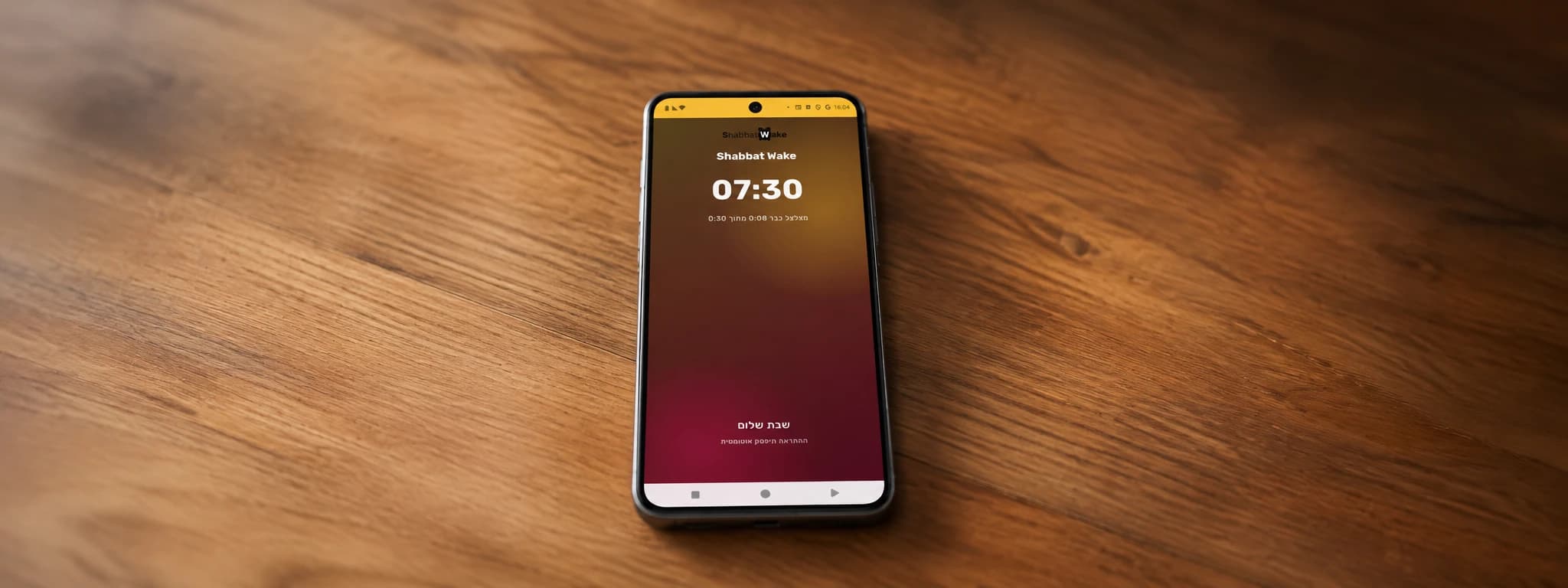
It started with a very simple need: I wanted to get to synagogue on time with my son.
I usually wake up more or less on time on Shabbat without an alarm. My biological clock does a pretty good job.
But my older son is at the age when waking up in the morning is... a little more complicated.
If I wake up at my usual time and only then start waking him, we’re already going to be late. So I need to get up about twenty minutes earlier, wake him, give him time to actually become a functioning human being, and then get us both out of the house.
And I really hate being late to synagogue.
Not because someone is checking the clock at the door, but because I want to be there from the beginning. Tefillah is an important part of Shabbat for me, and arriving halfway through just doesn’t feel the same.
So I built myself an alarm.
Nothing ambitious. I just wanted to set it before Shabbat, choose how long it should ring, and know that when the time comes it will wake me up and then stop by itself — without touching the phone.
It worked.
Then my son said, “Why don’t you publish it?”
I wasn’t really planning to build a product. But he had a point.
So I published it.
That was the beginning of Shabbat Wake.

Then other people started using it.
At first, it was just a few friends and family members.
Then neighbours started using it. Then more people from the community. At some point, a couple of schools where students stay for Shabbat started using it too.
And then something I hadn't really expected happened — messages started coming from people in other countries.
Different places, different languages, different communities. But everyone had more or less the same reason for using Shabbat Wake: they wanted to be somewhere on time on Shabbat without having to touch their phone.
So I started adding translations, fixing little things that worked differently for different people, and adding more ways to customize the alarm.
What started as something I built for myself and my son was slowly becoming useful to people I had never met.
And I think that's the part of the story I like the most.
One app. One purpose.
As more people started using Shabbat Wake, more ideas naturally came with it.
Maybe add zmanim. Maybe a siddur. Maybe more Jewish content. Maybe turn it into something much bigger.
But I keep coming back to the reason I built it in the first place.
I needed a reliable way to wake up on Shabbat, get my son up, and make it to synagogue on time.
That is still what Shabbat Wake is for.
Of course, the app should keep getting better. More reliable. Easier to use. Better translated. More flexible for different routines and different needs. And when people send feedback, report a bug, or ask for something that genuinely improves the alarm, I try to build it.
But I would rather make one Shabbat alarm really good than slowly turn Shabbat Wake into another app that tries to do everything.
There are already good apps for zmanim, siddurim, Jewish calendars and content. Shabbat Wake does not need to become one of them.
At the same time, keeping a simple app reliable still takes work.
As more people started using Shabbat Wake, there was more to maintain — testing on different phones, keeping up with Android changes, fixing bugs, improving translations, responding to feedback, and making sure the app keeps working the way people expect it to.
I also never wanted to fill Shabbat Wake with ads.
So I created the Supporter plan for people who find the app useful and want to help me continue maintaining and improving it. The free version still does the job Shabbat Wake was originally built to do, while supporters get longer alarm durations as my way of saying thank you.
Every person who chooses to support Shabbat Wake helps me keep maintaining it, improving it, and responding to the people who use it.
And I am genuinely grateful for that.
Shabbat Wake started as something I built for my family. I want it to keep getting better without losing the simple purpose that made me build it in the first place.